AI assisted Salesforce delivery for Life Sciences
With Megnity, your team uses a working Salesforce prototype before the scope is finalized and the fixed price is agreed. Phase 1 is targeted to go live in 2–3 months for a typical scope, subject to timely client inputs.
Why early feedback matters
A Salesforce project can become harder to manage when users first experience the system during user acceptance testing, after the main design and build decisions have been made. Missing requirements can then lead to rework, delays and changes to the agreed scope.
Three common points need attention:
Repeated discovery. Information can lose context as it moves from the Salesforce account team to the implementation partner. Reusing existing meeting notes gives the team a starting point and helps focus follow-up discussions on genuine gaps.
Pricing before requirements are clear. A fixed price is easier to agree when both teams understand the scope, assumptions and responsibilities.
Feedback after the build. Users often recognize what is missing when they try a screen or workflow. Getting that feedback earlier helps the team address it before implementation progresses.
How Megnity starts the project
We use AI to help prepare a draft scope and identify where requirements fit standard Salesforce capabilities or need additional work. A Megnity architect reviews the output, and we play back the requirements and assumptions with your team.
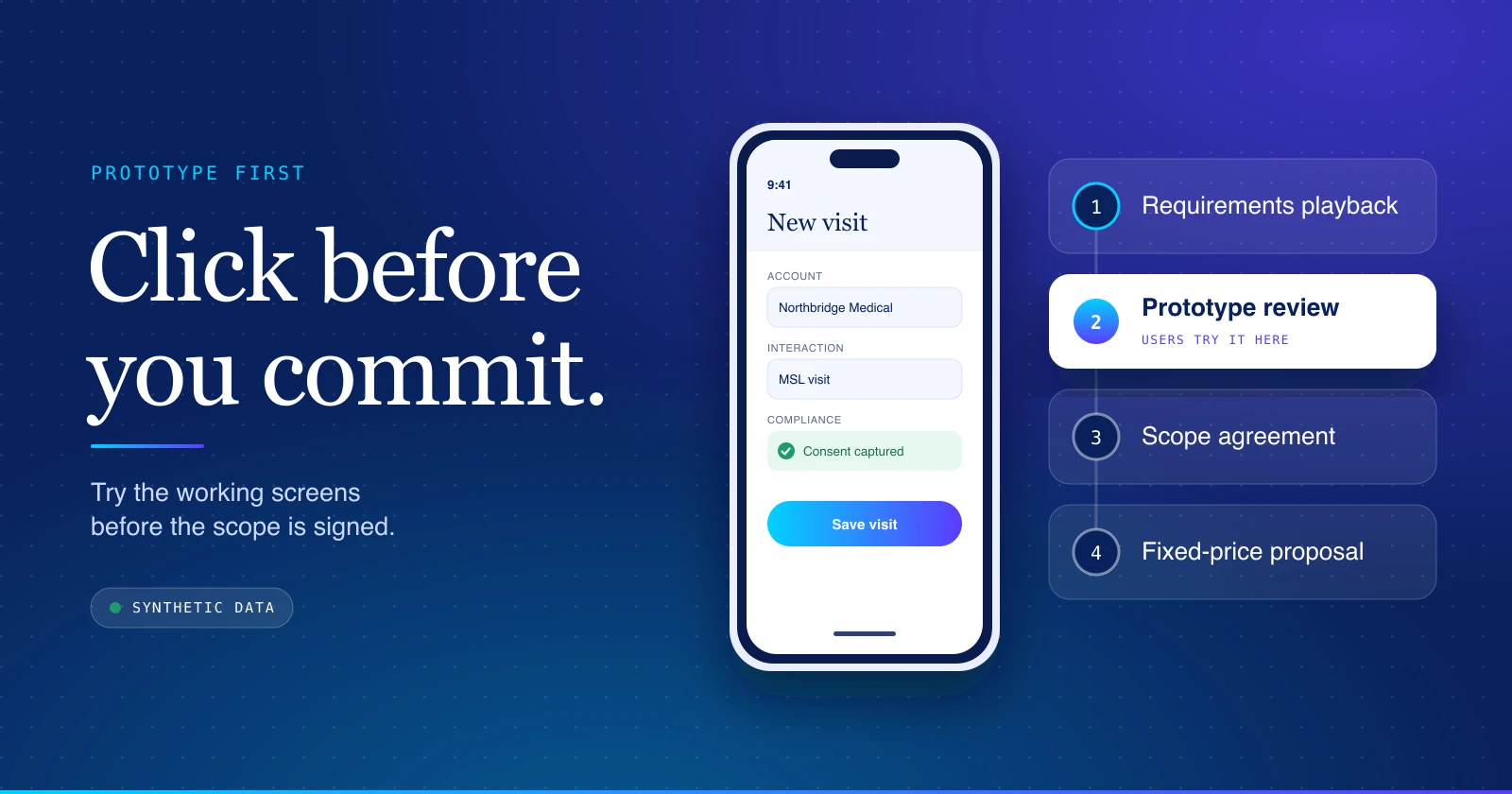
Your users then review a working prototype built with synthetic data. Their feedback helps finalize the scope before we issue the fixed-price proposal. Any missing information is clarified during this process.
The sequence is consistent: requirements playback, prototype review, scope agreement, then the fixed-price proposal.
Use a prototype before agreeing the scope
A working prototype gives your team something practical to review alongside the written requirements. A medical science liaison can try the visit-logging flow. A commercial operations lead can check the account hierarchy. A compliance owner can review where consent is captured.
The prototype uses synthetic data only, with no real patient or healthcare professional (HCP) data. It helps users identify gaps, clarify expectations and agree how the solution should work before the scope is finalized.
Requirements, assumptions and decisions are still documented. The prototype adds a practical way to confirm them.
See progress every week
After the scope and proposal are agreed, small delivery pods build in a weekly rhythm. Builders use Claude Code, architects review the work, and a separate person validates each feature.
| Day | What happens | What your team sees |
| Monday | Plan with your product owner. | The features planned for the week. |
| Tuesday and Wednesday | Build with AI assistance and architect review. | Progress in the Salesforce sandbox. |
| Thursday | A separate validator tests; the pod addresses issues. | Test results and identified fixes. |
| Friday | Deploy the reviewed work to the agreed environment and demonstrate it. | A working demo and an opportunity to give feedback. |
The aim is to build, validate and demonstrate a typical feature within a week. Complex features may need more time. Weekly deployments follow the agreed testing, approval and release controls; a demo does not automatically mean a production release.
Plan delivery in phases
Phase 1 is targeted to go live in 2–3 months for a typical scope, subject to timely client inputs. The plan needs to account for integrations, data readiness, testing and any applicable validation requirements.
User acceptance testing remains part of delivery. The prototype provides early feedback; testing confirms that the implemented solution works as intended.
Keep people responsible for quality
Our approach is simple: AI drafts, people decide. AI supports the work, while named people review outputs and remain responsible for decisions.
Human ownership. Every AI output has a named owner. The architect reviews design, data and security before work is promoted to the next environment.
Independent validation. The person who validates a feature is different from the person who built it.
Controlled data use. Prototypes use synthetic data. Our policy is that no personal data is entered into AI tools, and only approved tools are used.
Traceable delivery. Source control and repeatable deployments are in place from the beginning. Completed work is reviewed, tested and demonstrated to the customer.
For regulated Life Sciences processes, validation, documentation and approval requirements need to be considered as part of the delivery plan.
Continue support after go live
Each live phase moves into fixed-price support with a named support person, based on the agreed support scope. The next phase can be built while the earlier phase is already in use.
New requests are assessed for a later phase rather than added informally to the current scope. Each phase follows the same cycle of requirements playback, prototype review, scope agreement, build and testing.
Why Megnity
Megnity Technologies designs, builds and supports Salesforce, data and AI solutions, with a focus on Life Sciences. Our teams in Chandler, Arizona and Hyderabad, India bring together industry understanding, platform expertise and delivery experience.
| Experience | Details |
| Salesforce credentials | Select Partner, Data Cloud Expert, Agentforce Partner Network and Salesforce Professional Services Partner |
| Salesforce certifications | 200+ |
| Certified consultants | 115+ |
| Clients | 100+ |
| Salesforce AppExchange rating | 4.99/5 |
Frequently asked questions
What is AI-assisted Salesforce delivery?
It is an approach in which AI helps draft requirements, build code and support testing, while named people review, decide and sign off throughout delivery.
When do users see the system?
Users try a working prototype before the scope is finalized and the fixed-price proposal is issued. This gives them a practical way to provide feedback early.
How quickly can Phase 1 go live?
Phase 1 is targeted to go live in 2–3 months for a typical scope, subject to timely client inputs. The delivery plan also considers data, integrations, testing and applicable validation requirements.
Does the prototype replace requirements documentation or testing?
No. Requirements and decisions are documented, and the implemented solution still goes through the agreed testing and user acceptance process. The prototype helps confirm the direction earlier.
Is real patient or HCP data used in the prototype or AI tools?
Prototypes use synthetic data only. Our policy is that no personal data is entered into AI tools. Only approved tools are used, with architect review of design, data and security.
How is quality checked when AI helps write code?
Every AI output has a named human owner. A separate validator checks each feature, supported by source control, testing and repeatable deployments.
What happens after go-live?
Each live phase moves into fixed-price support with a named support person, based on the agreed scope. Further phases can then be planned and delivered.
Which technologies can be involved?
Our work can include Salesforce Sales Cloud, Service Cloud, Health Cloud, Life Sciences Cloud, Agentforce and Data 360, along with Databricks for data engineering and analytics.
See how this could work for your team
Share the meeting notes and documents from your Salesforce scoping conversations. We’ll review the requirements, clarify gaps and arrange a playback with your team. Prototype review and scope agreement follow before the fixed-price proposal is issued.