
Your organization has invested millions in Salesforce. Leadership expects cleaner forecasts, sharper client or HCP engagement and tighter compliance. So why does the same adoption pattern keep repeating — and what does it actually take to fix it?
You are not alone. The industry data is sobering:
In pharma, low adoption is not just a productivity problem. It is a commercial, compliance, and strategic risk. Inaccurate forecasts mislead supply planning. Missing activity data weakens MLR and regulatory defensibility. Ops teams burn cycles cleaning data that should never have been dirty. And the Salesforce investment — the one the board approved — quietly underperforms. At Megnity, we have spent years helping pharma and life-sciences organizations turn underused Salesforce environments into systems reps reach for. What we have learned is that adoption is never an accident. It is engineered, and it rests on ten deliberate commitments.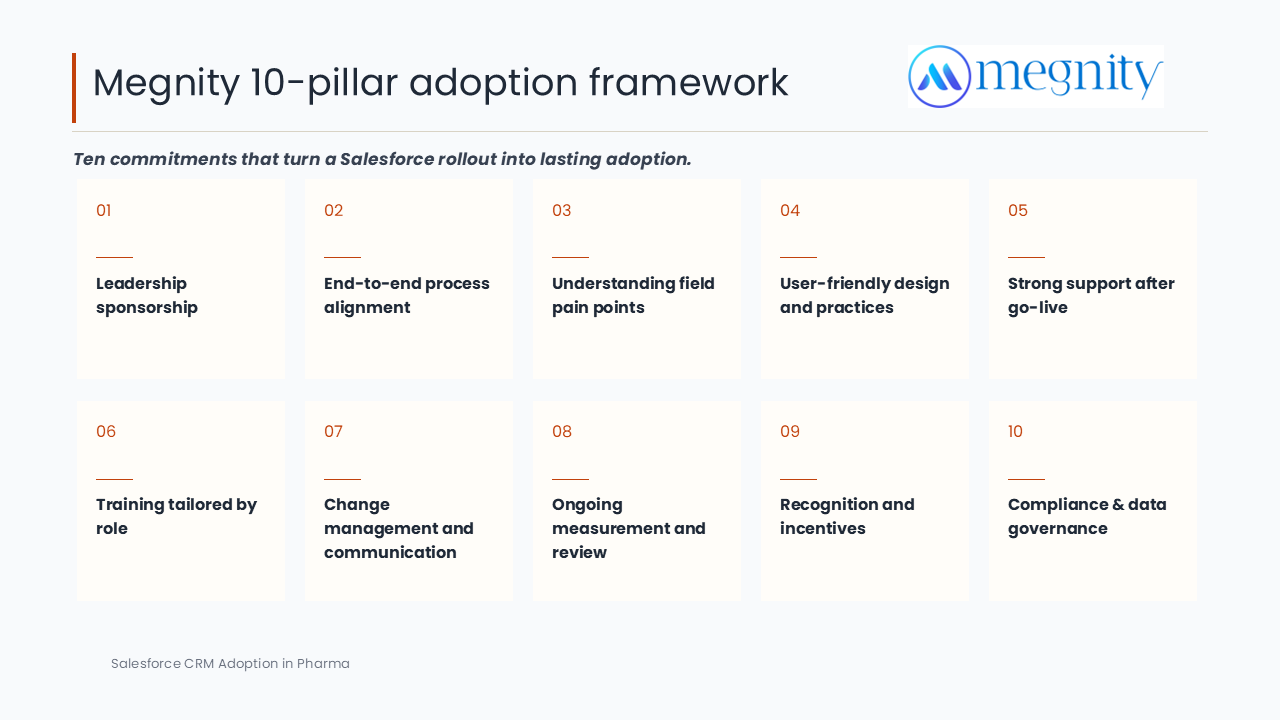
The pattern we see repeatedly: organizations that treat adoption as a project stall at 40–50%. Organizations that treat adoption as a leadership commitment compound past 80% — and unlock the 5.6× ROI the industry data promises.
Each of these is achievable within a quarter. Together, they transform Salesforce from a reporting system into a field productivity platform — the outcome your original business case promised.
The uncomfortable truth about CRM in pharma
Your organization has invested millions in Salesforce. Leadership expects cleaner forecasts, sharper client or HCP engagement, and tighter compliance. Yet quarter after quarter, the same pattern repeats: reps keep side-spreadsheets, call logs arrive late (or never), and pipeline reviews still start with “let me check my notes.”You are not alone. The industry data is sobering:
70% of CRM implementations fail to meet adoption targets
43% of life-sciences reps say CRM slows their workflow
5.6× higher ROI for companies with >80% CRM adoption
$0 value captured when reps don’t log activity
In pharma, low adoption is not just a productivity problem. It is a commercial, compliance, and strategic risk. Inaccurate forecasts mislead supply planning. Missing activity data weakens MLR and regulatory defensibility. Ops teams burn cycles cleaning data that should never have been dirty. And the Salesforce investment — the one the board approved — quietly underperforms. At Megnity, we have spent years helping pharma and life-sciences organizations turn underused Salesforce environments into systems reps reach for. What we have learned is that adoption is never an accident. It is engineered, and it rests on ten deliberate commitments.
Why CRM adoption is uniquely hard in pharma
Before prescribing solutions, it helps to name the forces working against you. Pharma is not a generic B2B sales environment and treating it like one is the single biggest reason for rollouts stall.1. One process does not fit all roles
Primary-care reps, specialty reps, KAMs, MSLs and market-access teams each operate in fundamentally different rhythms. A single standardized workflow forces most of them into friction.2. Compliance raises the cost of every click
PhRMA Code, Sunshine Act, GDPR/HIPAA and internal MLR controls all add required fields, approvals and audit trails. Without thoughtful design, compliance feels like punishment for using the system.3. Shadow systems persist
Excel, email and OneNote don’t disappear on go-live day. If the CRM is slower than the shadow system, the shadow system wins.4. Reps perceive CRM as a management tool
If the only obvious beneficiary of the data is the home office, field users will log the minimum.5. Mobile and offline reality
Reps work in clinic parking lots, between site visits and in locations with poor connectivity. A desktop-first design loses before it starts.6. Data quality erodes trust
Once reps see stale territory alignments or duplicate account/contact records, they stop believing the system — and stop contributing to it.The Megnity 10-Pillar Adoption Framework
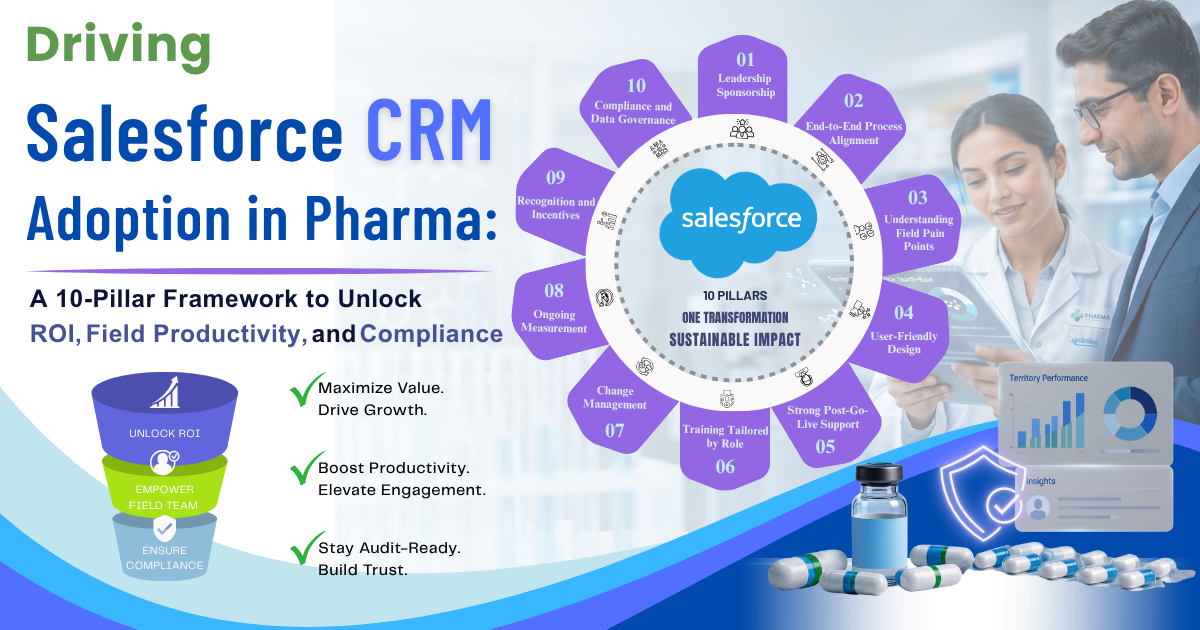
Every successful pharma Salesforce program we have worked on has reinforced the same ten pillars. Miss one, and adoption plateaus. Nail all ten, and adoption compounds.
PILLAR 01: Leadership sponsorship
A business leader — not IT — owns adoption and reviews it in every commercial forum.PILLAR 02: End-to-end process alignment
Fit Salesforce to how the business actually runs before a single field is built.PILLAR 03: Understanding field pain points
Ride-alongs reveal the real requirements that workshops never surface.PILLAR 04: User-friendly design
Design for the 80% daily actions. Log a call in under 90 seconds on a phone.PILLAR 05: Strong post-go-live support
The first 60 days decide the next 5 years. Dedicated hypercare with fast SLAs.PILLAR 06: Training tailored by role
Short, scenario-based, role-specific sessions tied to real day-in-the-life work.PILLAR 07: Change management
“You said / we did” communication cadence that earns trust quarter over quarter.PILLAR 08: Ongoing measurement
Track quality of usage — completeness, timeliness, relevance — not logins.PILLAR 09: Recognition and incentives
Reward consistent CRM behavior publicly. Recognition beats enforcement.PILLAR 10: Compliance and data governance
Embed compliance into workflows so doing the right thing is the easy thing.The pattern we see repeatedly: organizations that treat adoption as a project stall at 40–50%. Organizations that treat adoption as a leadership commitment compound past 80% — and unlock the 5.6× ROI the industry data promises.
What we have seen actually work
Across Megnity’s life-sciences engagements, a consistent set of patterns separates the programs that stick from the ones that stall:- When senior leaders visibly use the CRM in their own reviews, adoption follows within one to two quarters.
- Aligning business processes before configuration cuts downstream rework and user resistance dramatically.
- Field ride-alongs uncover practical issues no requirements workshop ever will.
- Simple, mobile-first design drives more daily usage than any advanced feature ever has.
- Strong hypercare in the first 60 days prevents the quiet, permanent reversion to spreadsheets.
- Short, role-specific training outperforms generic multi-hour sessions every time.
- Continuous communication is the single most undervalued lever in change management.
- Tracking quality of usage enables coaching instead of finger-pointing.
- Recognition drives more sustained behavior change than enforcement.
- Embedded compliance protects the business and the user simultaneously.
A practical action plan for pharma leaders
If you are a Commercial Ops, IT or Digital leader reading this and recognizing your own program, here is where we recommend starting:1. Appoint a single business owner for CRM adoption — not the CIO, not the Salesforce admin. A commercial leader with a seat at the revenue table.
2. Run a 30-day process and pain-point discovery with the field before touching configuration.
3. Redesign your top three highest-frequency activities (call logging, sample management, follow-ups) for speed and mobile-first use.
4. Stand up a 90-day hypercare pod with a visible “you said / we did” communication cadence.
5. Rebuild your adoption scorecard around quality metrics — completeness, timeliness, relevance — not logins.
6. Tie recognition and a small portion of incentive comp to data quality behaviors.
7. Bake compliance into the workflow so reps never have to choose between speed and safety.
Each of these is achievable within a quarter. Together, they transform Salesforce from a reporting system into a field productivity platform — the outcome your original business case promised.


No Comments